Who Came Up With a Slogan Never Again
(JTA) — After a gunman took the lives of 17 students and staff at their loftier school in Parkland, Florida, students in that location launched a national campaign to promote gun control. They called for a major protest in Washington, D.C., on March 24, and are encouraging similar protests and pupil walkouts across the country.
And they took a proper name for their campaign, #NeverAgain, that has long been linked to Holocaust commemoration.
Parkland junior Cameron Kasky is credited with coining the hashtag. A Twitter account for the movement, NeverAgainMSD, is described as "For survivors of the Stoneman Douglas Shooting, by survivors of the Stoneman Douglas Shooting."
Some supporters of the students' efforts are put off by their use of Never Again. Lily Herman, writing in Refinery29, said "it'south very uncomfortable to sentinel a term you've used to talk about your family unit and people's ain heritage and history be taken away overnight."
Malka Goldberg, a digital communications specialist in Maryland, tweeted, "When I saw they're using #NeverAgain for the entrada it bothered me, b/c many Jews strongly [associate] that phrase w/ the Holocaust specifically. For a 2d information technology felt like cultural appropriation, merely I doubt the kids knew this or did it intentionally."
Hasia Diner, a p rofessor of American Jewish history at New York University, is unfazed past the students' use of the phrase. While some may object to the phrase Never Once more being reappropriated for gun control, it "does not hateful that reaction is appropriate or reasonable," she told JTA.
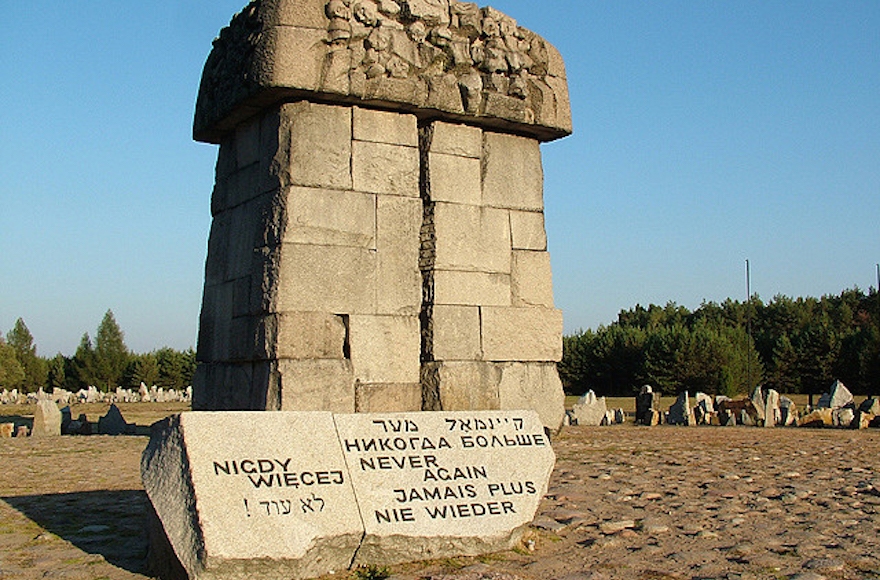
The "big stone" monument in Treblinka commemorating the thousand of Jews who were murdered at the Treblinka expiry army camp, with the inscription "Never Again" written in vi languages. (euroIL via CC)
While some take traced the phrase to the Hebrew poet Isaac Lambdan's 1926 poem "Masada" ("Never shall Masada fall again!"), its electric current use is more direct tied to the backwash of the Holocaust. The first usage of Never Over again is murky, but most likely began in postwar State of israel. The phrase was used in secular kibbutzim in that location in the tardily 1940s; it was used in a Swedish documentary on the Holocaust in 1961.
But the phrase gained currency in English thanks in large role to Meir Kahane, the militant rabbi who popularized information technology in America when he created the Jewish Defence force League in 1968 and used it as a title of a 1972 book-length manifesto. As the president of the American Jewish Committee, Sholom Comay, said after Kahane'south bump-off in November 1990, "Despite our considerable differences, Meir Kahane must ever be remembered for the slogan Never Again, which for so many became the battle cry of post-Holocaust Jewry."
For Kahane, Never Over again was an implicitly violent call to arms and a rebuke of passivity and inactivity. The shame surrounding the alleged passivity of the Jews in the face of their destruction became a cornerstone of the JDL. As Kahane said, "the motto Never Again does non mean that 'it' [a holocaust] will never happen again. That would be nonsense. It ways that if it happens over again, it won't happen in the same manner. Concluding fourth dimension, the Jews behaved like sheep."
Kahane used Never Again to justify acts of terror in the proper name of fighting anti-Semitism. In the anthem of the Jewish Defense League, members recited, "To our slaughtered brethren and solitary widows: Never again volition our people's blood be shed by water, Never again volition such things be heard in Judea."
Later, however, Kahane's violent call for action was adapted by American Jewish establishment groups and Holocaust commemoration institutions as a call for peace, tolerance and heeding the alarm signs of genocide.
These days, when the phrase is used to invoke the Holocaust, it can be either particular or universal. Israeli Prime Minister Benjamin Netanyahu tends toward the detail when he uses information technology to speak near the need for a stiff Jewish state in the wake of the Holocaust.
"I hope, as head of the Jewish state, that never over again will we let the hand of evil to sever the life of our people and our land," he said in a voice communication at the site of the former Auschwitz-Birkenau expiry campsite marking International Holocaust Memorial Day in 2010.
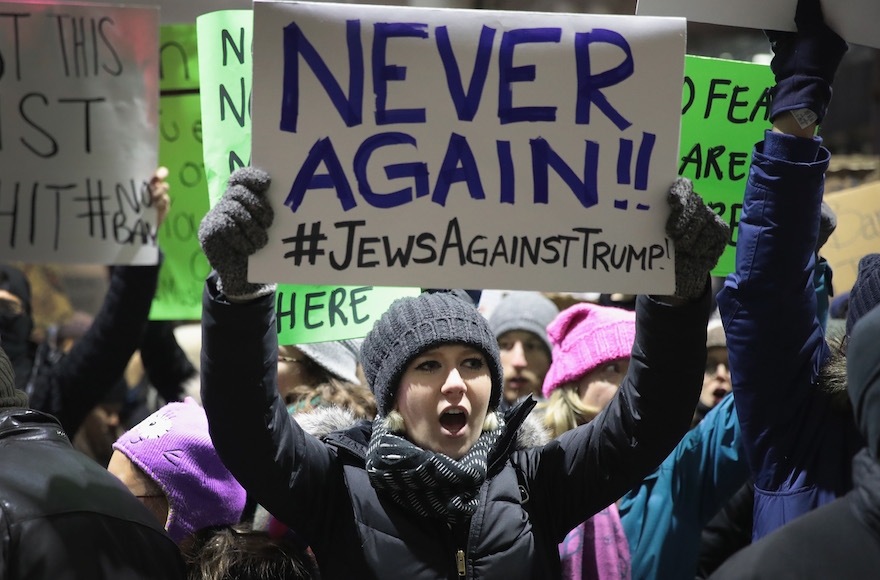
Demonstrators at Chicago's O'Hare Aerodrome protesting Donald Trump's executive order imposing a freeze on admitting refugees from sure countries into the United States, January. 29, 2017. (Scott Olson/Getty Images)
Merely Netanyahu has also used the phrase in its universal sense of preventing all genocides. After visiting a memorial to the victims of the Rwanda genocide in 2010, Netanyahu and his married woman, Sara, wrote in the guestbook, "We are securely moved by the memorial to the victims of one history's greatest crimes — and reminded of the haunting similarities to the genocide of our own people. Never again."
So-President Barack Obama also used the phrase in its universal sense in mark International Holocaust Remembrance Twenty-four hours in 2011.
"We are reminded to remain ever-vigilant against the possibility of genocide, and to ensure that Never Again is not but a phrase just a principled cause," he said in a argument. "And we resolve to stand upward against prejudice, stereotyping, and violence – including the scourge of anti-Semitism – effectually the globe."
That'southward similar to how the U.Southward. Holocaust Memorial Museum uses the phrase. In choosing the proper noun Never Again as the theme of its 2013 Days of Remembrance, its used the term as a telephone call to study the genocide of the Jews in order to respond to the "warning signs" of genocides happening anywhere.
And Elie Wiesel, the Holocaust survivor and author who came to exist associated with the phrase, also used it in the universal sense.
"'Never again' becomes more than than a slogan: It's a prayer, a promise, a vow … never once again the glorification of base, ugly, dark violence," the Nobel laureate wrote in 2012.
Never Once again is a phrase that keeps on evolving. It was used in protests confronting the Muslim ban and in support of refugees, in remembrance of Japanese internment during World State of war 2 and recalling the Chinese Exclusion Human activity of 1882 . And now the phrase is taking on notwithstanding another life: in the fight for gun control in America.
Shaul Magid, a professor of Jewish studies at Indiana University who is presently a visiting scholar at the Middle for Jewish History in New York, told JTA, "For [Kahane], Never Again was not 'this will non happen again considering we volition have a country' merely 'we Jews will never be conceited like we were during the war.' That is, for Kahane, Never Again was a telephone call to militancy as the only deed of prevention. In Parkland it is a call for gun control. In a style, a call for anti-militancy."
It's hundred-to-one Kahane would take appreciated the term being co-opted past a gun control campaign. His 2nd most-famous slogan was "Every Jew a .22."
Source: https://www.jta.org/2018/03/08/united-states/never-evolved-holocaust-slogan-universal-call-fill-blank
0 Response to "Who Came Up With a Slogan Never Again"
Post a Comment