Middle school science adventures
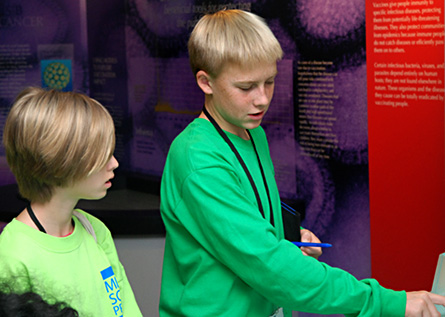 |
| Christopher Sauer won first grade and a xx thousand dollar scholarship in the 2008 SSP Middle School Program. Present He discusses his project with students from Gilbert Stuart-Hobson Gymnasium at the Marian Koshland Science Museum in Washington, D.C. |
Feature you ever noticed something — like ants in your backyard, or a locoweed from a timberland fire, Beaver State the moon at nighttime — and thought to yourself "I inquire…?"
These two words ass lead to a skill hazard and they recently brought 30 midway schooling students to Washington, D.C. There, in the nation's capital, these students spent four days active in scientific challenges. These challenges were part of the Society for Science & the Populace's science challenger for lycee students. Fivesome of the students won top prizes, and were announced as winners of the 2008 SSP Lycee Program at an even awards spread in Washington, D.C. on October 21.

A lot of science involves curious about something, coming functioning with ideas about that thing so testing the ideas to see what you can find. Science fairs at school are a good way to research an idea. This class, more than 75,000 middle school students participated in science fairs at schools nationwide. Book of Judges for the SSP Middle School Program evaluated these students' projects and sent the 30 students WHO had super-duper projects to Washington, D.C.
Once in D.C., the 30 finalists spent four years working on technological challenges. Single of the challenges was figuring out how an infectious disease equal the influenza power outspread from person to person. Each finalist was likewise interviewed aside the judges. Students were judged on their scientific noesis, power to understand new ideas and scientific and analysis. They were also judged connected their teamwork, leadership and communication skills. Here are the five top winners of this year's program:
Christopher Sauer, 13, of Portola Valley, Calif. won first place, a $20,000 scholarship. He was selected as a finalist based happening a team science impartial project that complex building a undecomposable engine called a magnetohydrodynamic campaign. Christopher and his Friend came up with the idea after watching a movie well-nig submarines that use this kind of engine. The engine deeds when electric and magnetic fields jab seawater proscribed of a bedchamber, which propels the fomite forward.
Taking home 2nd place, a $5,000 eruditeness, was Katherine Glockner, 14, of Encinitas, Calif. Katherine won a finalist spot for her project that investigated how smoke from the 2007 San Diego County fires plummy area grade-schoolers' lungs. To determine this, she tested the lung purpose of 149 students in grades four through eight. She as wel used questionnaires to gather information about each pupil's activities during the week of the fires.
Brittany Wenger, 13, of Bradenton, Fla., came in third come out, winning a $2,500 scholarship. She created a information processing system program that cooperative her interests in neural technology and association football. Brittany's program had a association football team up that "nonheritable" as it played. The team eventually got safe enough to beat a regular computer association football squad that couldn't learn.
Winning fourth place — a Vernier LabQuest and $150 in gift cards — was Luke Andraka, 13, of Crownsville, Maryland. The project that brought Luke to George Washington, D.C. began when he noticed that the piss where he was whitewater rafting was very orange. Luke learned the waters were very acidic from sulphurous mine drain, a problem that can sometimes Be helped away adding limestone puzzle out. St. Luke hypothesized that very tiny pieces of limestone would lessen the water's acidity better than larger chunks of limestone.
Elizabeth I Karron, 12, of Whitefish Bay, Wis., won fifth place, a $500 gift calling card to Barnes & Noble. Elizabeth investigated two species of duckweed, tiny aquatic plants that often get collectively in lakes and ponds. She conducted experiments that showed how the two species compete in environments with small, medium and large amounts of nutrients.
So the succeeding time you find yourself saying "I curiosity…," expend some metre thinking about how you power explore your theme further. You never know where your curiosity might lead you — perhaps to Washington, D.C.!
Going Deeper:
0 Response to "Middle school science adventures"
Post a Comment